16  Endocrinology

16.1 Hypoglycemia


Hypoglycemia definition

Age-dependent criteria (based on regional agreement):

  • Birth to < 48 hrs of life: 45mg/dL
  • ≥ 48 hrs of life: 60mg/dL


Family Care Center approach to hypoglycemia screening

[Download]

Target population

  • GA < 37 weeks
  • BW ≥ 4,000g
  • BW ≤ 2,500g
  • IDM
  • Other infants identified at the discretion of the provider

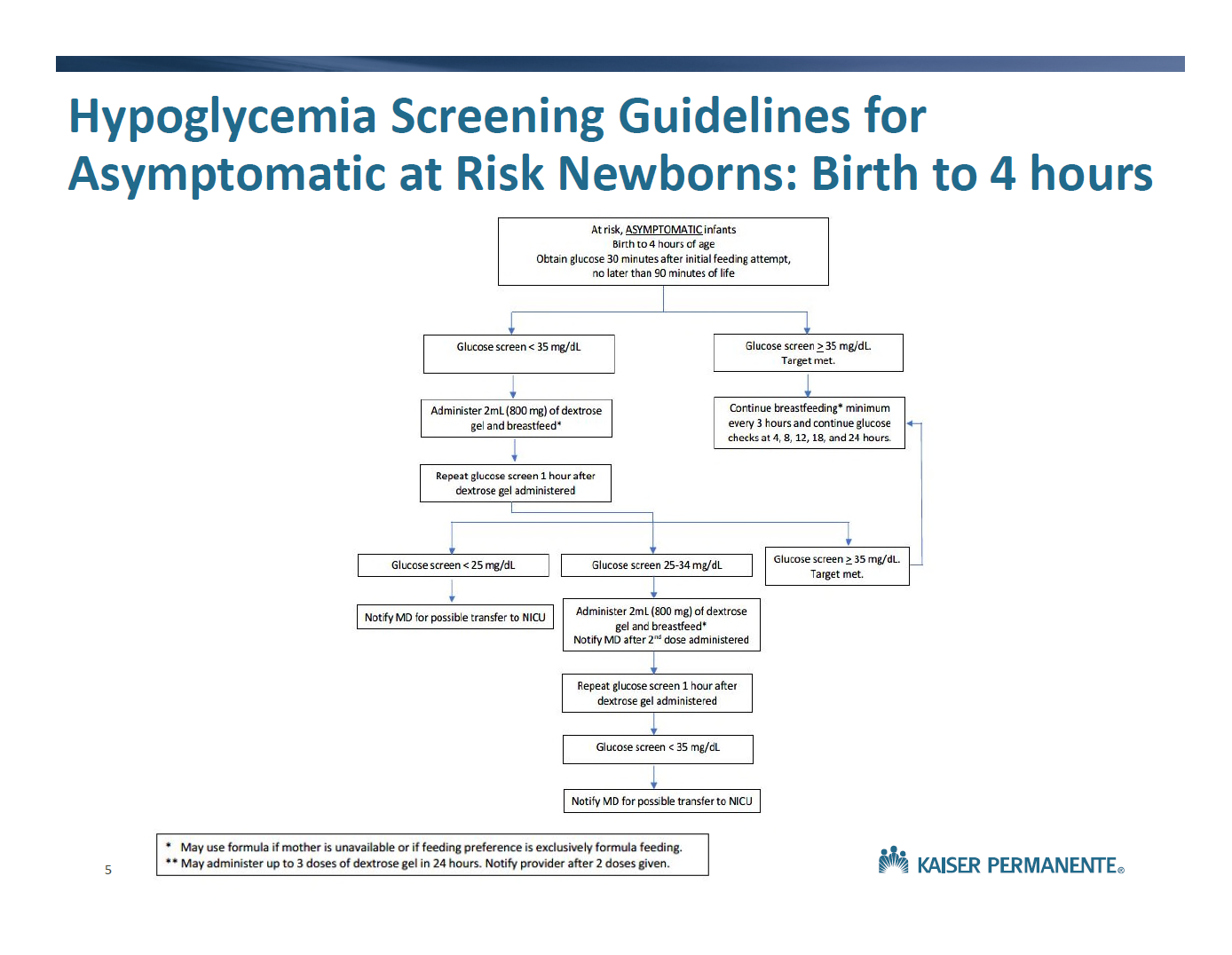
0-4 hours of life

Goal: Glucose ≥ 35 mg/dL

Hypoglycemia screening guidelines for asymptomatic at risk newborns: 0-4 hours

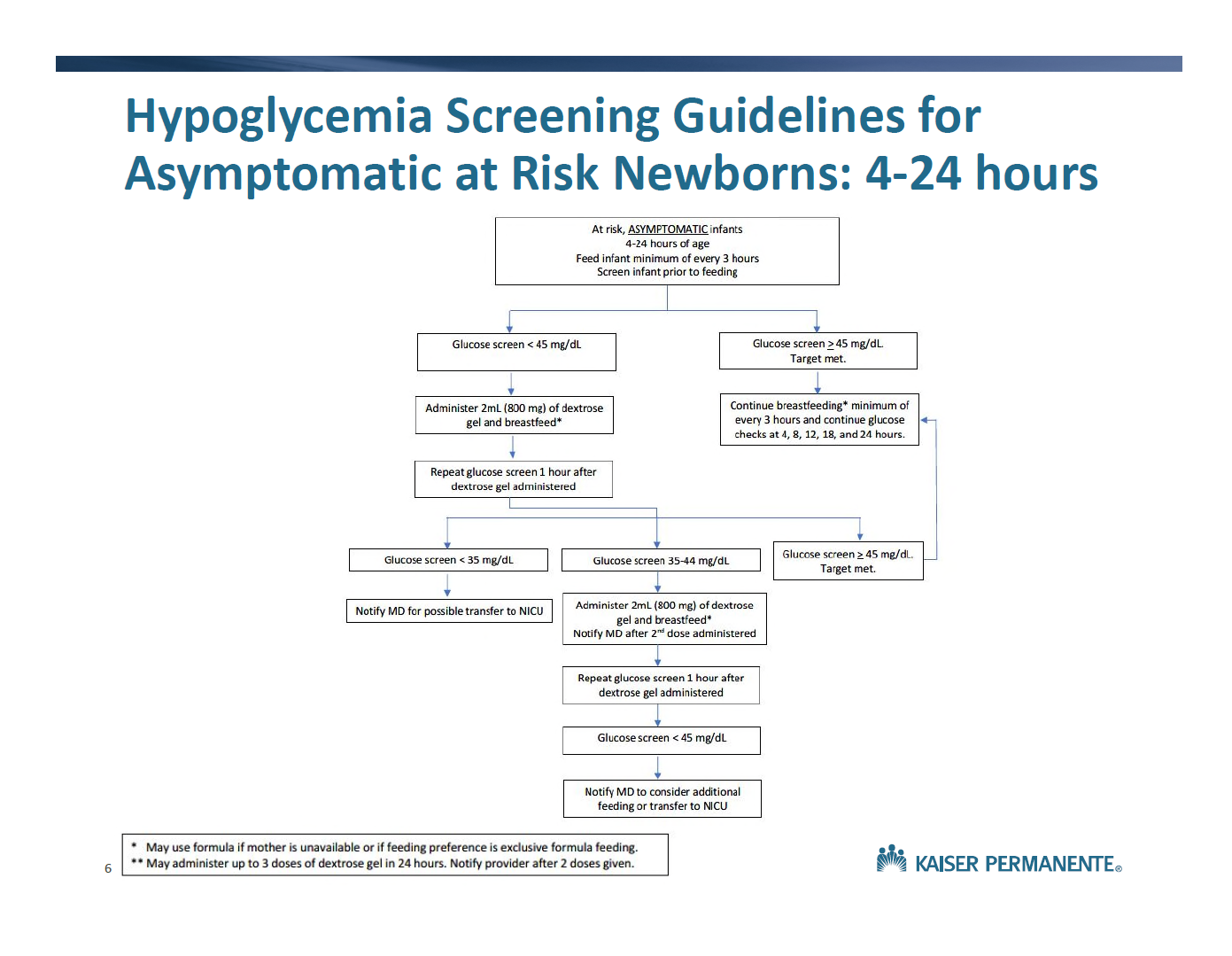
4-24 hours of life

Goal: Glucose ≥ 45 mg/dL

Hypoglycemia screening guidelines for asymptomatic at risk newborns: 0-4 hours


Critical labs for refractory hypoglycemia

Indication

Consider obtaining critical laboratory tests for infants requiring a glucose infusion rate greater than 10 mg/kg/min, when, based on gestational and chronological age, they would not typically require intravenous fluids.


Laboratory tests to order

  • Tier 1
#ID Code Description Tube Volume
1 82947A Serum glucose PST4 green top 0.4ml
2 83525B Insulin GLD6 gold top 0.4ml
3 82533A Cortisol GLD6 gold top 0.4ml
4 82010A Beta-hydroxybutyric acid GLD6 gold top 1ml
5 83003B Human growth hormone RED7 red top 1ml
6 80051P Electrolyte panel PST4 green top 0.2ml
  • Tier 2
#ID Code Description Tube Volume
1 84210B Pyruvic acid Special tube/handling instructions:
contact lab
1ml
2 82140B Ammonia Special tube/handling instructions:
contact lab
0.4ml
3 82024B ACTH Special tube/handling instructions:
contact lab
1ml
4 82533U Cortisol, Neonatal RED7 red top 0.4ml
5 84443B TSH GLD6 gold top 0.4ml
6 84439B T4, free GLD6 gold top 0.4ml
7 82725B Free fatty acids RED7 red top 0.6ml
8 82017B Acylcarnitine profile, plasma GRN5 green top 1ml
9 82139C Amino acids, plasma GRN5 green top 2ml
10 83918C Organic acids, urine Urine container 15ml
  • Tier 3

    Blood gas for pH, BE, and lactate


Possible blood specimen source

Capillary:

  • Heel stick

Venous:

  • Freshly placed PIV
  • UVC
  • PowerPICC (not routinely seen in our NICU)

Arterial:

  • Radial/ulnar artery puncture
  • UAC
  • PAL


Procedure for inducing hypoglycemia (need to discuss further)

  1. Identify the lab tests, verify order entry.
  2. Determine the total volume needed.
    Physicians should be mindful of the practicality of the exsanguinated volume.
  3. Identify the source of blood specimen.
  4. D10W 2mL/kg bolus syringe available at bedside.
  5. Discontinue IV fluid.
  6. Check POC glucose every 30min until level < 55mg/dL.
  7. Check POC glucose every 15min until level < 45mg/dL.
  8. Obtain blood specimen.
  9. Check POC glucose. If < 40mg/dL, administer D10W 2mL/kg bolus once.
  10. Restart IV fluid.
  11. Check POC glucose every 30min until > 60mg/dL.


Sliding scale for IV dextrose weaning

Need consensus

  • Wean by 2ml/hr for AC POC Glucose >80 (or 75)
  • Wean by 1mL/hr for AC POC Clugose 70-80 (or 65-75)
  • Increase by 1mL/hr for AC POC glucose 50-60 (or 45-55)
  • Increase by 2mL/hr for AC POC Glucose < 50 (or <45), and notify MD
  • Once off IV, continue to check sugars until >60 on 3 consecutive checks.


16.2 Secondary Screening for Neonatal Thyroid Conditions


Indications and Screening

Indication Screening needed
Monochorionic twins/Multiple (Same-sex if chorionic status not known) TSH at 2 weeks of age
ANY congenital heart disease diagnosis (exclude PDA) with infant hospitalized to at least day 14 TSH at 2 weeks of age
Very low birth weight (≤ 1500 grams) TSH at 2, 4, and 6 weeks of age if still hospitalized
Down syndrome TSH at 2 weeks
Mother with history of or active hyperthyroidism/Graves disease See: Managing Neonatal Graves Disease flowchart
Signs or symptoms of hypothyroidism (e.g., unexplained lethargy, bradycardia, jaundice, or constipation; abnormal neck imaging) TSH and Free T4 as soon as symptoms are recognized
Signs or symptom of central hypothyroidism or hypopituitarism (e.g., craniofacial/midline defects, certain genetic syndromes, recurrent hypoglycemia, recalcitrant hypotension, micropenis) TSH and free T4 along with other pituitary tests when signs or symptoms are recognized
Mother with hypothyroidism or Hashimoto thyroiditis and no history of Graves disease Routine newborn screen only
Important
  • Screening TSH ≥10 mIU/L is abnormal: immediately repeat TSH adding free T4 as well and discuss results once available with endocrinology promptly.
  • If the test will be performed as outpatient, please order the test and document under problem list thyroid disorder screening V77.0A
  • Consider TSH only in premature infants (without reflex free T4). Appropriate Health Connect Order: TSH, NO REFLEX (order 84443O).
  • If considering tests for strong suspicion of hypothyroidism or hypopituitarism, discussion with endocrinology is recommended for all results. If suspicion for pathology is low, discuss with endocrinology if results are outside reference range.


Guide for interpretation of thyroid function studies

Note

Normal values are not fully established in the first 2 months of life and interpretation may differ if tests are done for screening or for symptomatic/diagnostic purposes. Free T4 levels may be less in NICU due to illness unrelated to thyroid disease. Significant topical iodine exposure may transiently alter thyroid function tests. Interpret with caution.

Asymptomatic screening (0-60 days old)

TSH

  • Hypothyroidism screening: < 10mIU/L
  • maternal Graves/hyperthyroidism: use lab-provided reference

Free T4

  • Use lab-provided reference

Symptomatic/diagnostic testing

TSH

  • Newborn ≤ 3 days old: 1-20 mIU/L
  • Newborn > 3 days old: use lab-provided reference

Free T4

  • Newborn ≤ 14 days old: 1.4-2.8 ng/dL
  • Newborn > 14 days old: use lab-provided reference

16.3 Screening Guidelines for Neonatal Graves Disease

flowchart TD
  A["Mom with Graves Disease (hyperthyroidism) or history of Graves disease (hyperthyroidism)"] --> B["Obtain Thyroid Receptor Ab (TR Ab) or TSI in 2<sup>nd</sup>/3<sup>rd</sup> Trimester"]
  B --> C["Positive or unknwon TR Ab/TSI or<br>Negative TR Ab but active maternal hyperthyroidism<br><em>and/or</em><br>Treated with anti-thyroid drugs (PTU/methimazole)"]
  B --> D["NO current anti-thyroid treatment<br><em><u>and</u></em><br>NEGATIVE TR Ab/TSI in 2<sup>nd</sup>/3<sup>rd</sup> Trimester"]
  C --> E[High risk neonate]
  D --> F[No screening needed]
  E --> G["Obtain TR Ab/TSI in cord blood or nursery<br><em>If not done</em>: Order TR Ab/TSI, freeT4, TSH for outpatient draw in first 7 days of life"]
  G --> H["+ TR Ab/TSI = High risk neonate<br><em>(Observe for clinical symptoms of hyper/hypothyroidism)</em>"]
  G --> I["Negative TR Ab/TSI = Low risk neonate"]
  H --> J["Draw TSH and free T4 at 3-7 days<br><em>(if not done prior, or if symptomatic)</em>"]
  I --> K["No further work-up necessary"]
  J --> L["Abnormal results: send Dr. Advice to Peds Endo<br><em>(TSH < 1mIU/ml and/or free T4 > 2ng/dl is abnormal)</em>"]
  J --> M["Normal TSH, free T4 for age"]
  M --> K

Note

Though TSI is acceptable it is preferred to screen with TR Ab (TSH receptor binding antibody)


16.4 Ambiguous Genitalia

Differential diagnosis

XY individual

  • Defects in gene producing transcription factors along the pathway of testicular differentiation
  • Defects in androgen synthesis & production
  • Defect in androgen receptor response
  • Disrupted müllerian inhibition

XX individual

  • Gonadal overproduction of androgens due to mutations involved in gonadal (ovarian) development
  • Adrenal overproduction of androgens
  • Placental aromatase deficiency
  • Maternal exogenous exposure to androgens


Physical findings to trigger workup

Frankly atypical genital appearance

Subtle presentation

Male

  • micropenis:
    • Full-term: stretched penile length < 2.5cm
    • Preterm: normal stretched penile length (cm) = -2.27 + 0.16 x GA in week
  • severe hypospadias (with or without cryptorchidism or micropenis)

Female

  • clitoromegaly: width > 6mm or length > 9mm
  • posterior labial fusion, with anogenital ratio > 0.5
  • gonads palpable in the labioscrotal folds or the inguinal region


Workup

First days of life

STAT ORDERS

  • Serum eletrolytes
  • Serum glucose level
  • Random cortisol
  • 17-OHP: value affected by prematuirty, maternal steroid intake
  • Renin
  • Karyotyping

ROUTINE ORDERS

  • Ultrasound of the abdomen/pelvis
  • Growth hormone level (in the first 15 days of life)
  • Prolactin (can help diagnose growth hormone deficiency)
  • Free T4, free T4 by dialysis (can help diagnose hypopituitarism)

After 1 week of age and before 6-9 months of age (mini-puberty)

Assess pituitary gonadotropin function

  • Pediatric LH
  • FSH

Assess gonadal function

  • Estradiol
  • Testosterone
  • Dihydrotestosterone
  • Anti-Müllerian hormone
    • reference range: boys > 30ng/mL; girls < 10ng/mL
    • Higher AMH than female range (XX individual) indicates Sertoli cells present (ovotesticular DSD)
    • AMH below typical male range (XY individual) indicates defect in testicular function

Additional Workup

  • Skeletal survey
  • MRI of the Sella with and without contrast


Consultation

  • Pediatric endocrinology
  • Pediatric urology
  • Psychology
  • Genetics
  • Social worker
  • Medical ethics


Congenital adrenal hyperplasia (CAH) treatment

  • Fluid:
    • D5NS without K at 1-2x maintenance
    • consider 10mL/kg NS bolus if dehydrated
  • Glucocorticoids (hydrocortisone):
    • Start at 50mg/m2/day IV divided q4-6 hrs
  • Mineralocorticoirds:
    • Start fludrocortisone at 0.1mg qDay
  • NaCl supplement: Start at 3-4 mEq/kg/day (4mEq/mL solution)


16.5 Undescended Testicle


For unilateral undescended (or non-palpable) testicle

  • No need to order ultrasound
  • Refere to Peds Urology for evaluation (there is a new hire at Fontana)
  • May wait until 3 months of age to refer as some will descend by that time
  • If there are othe rmalformations of the external genitalia (hypospadias) with undescended testicle(s), obtain labs as below an refer to Peds Urology without waiting until 3 months.


For bilateral undescended (or non-palpable) testicle

flowchart TD

A["Perform exam carefully and  
   repeatedly in a warm, relaxed state"] --> C["Yes"]
A --> B["No"]
B --> D["If the exam is unclear or uncertain,  
         it is best to <strong>obtain ultrasound</strong>  
         first, per Peds Endo"]
           
D --> E["If true bilateral undescended testes  
         on ultrasound report, endocrine work-
         up should be ordered next."]
         
C --> F["If the provider is comfortable  
         in making the clinical assessment 
         without aid of ultrasound, then  
         endocrine workup should be 
         ordered next."]
        
F --> G["<div align='left';>
        1. Testosteron, pediatric
        2. LH, pediatric
        3. FSH
        4. AMH (anti-Mullerian hormone)
        5. Karyotype
        6. 17-OH progesterone
            
        Call Peds Endo. 
        
        Do NOT discharge baby or give sex assignment  
        until workup evaluated by Peds Endo.
        </div>
"]

E --> G

D --> H["If testes are high scrotum or   
         low in the inguinal canal,  
         refer to Peds Urology for exam   
         and follow-up.  
         Newborn screen for CAH."]